
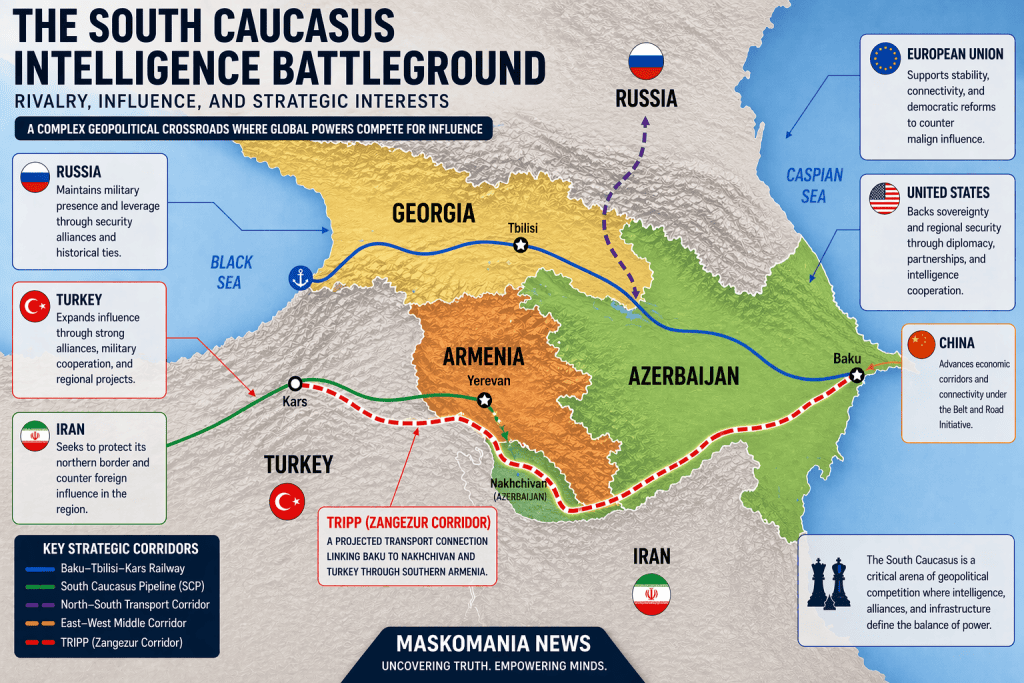
The South Caucasus intelligence battleground is no longer defined solely by post-war diplomacy. Beneath the surface of formal negotiations, a quieter but equally consequential contest is emerging—one shaped not only by military positioning and political alignment, but by intelligence activity, strategic signaling, and covert competition.
At the same time, the ongoing conflict involving Iran and Western-aligned forces has significantly reshaped the broader geopolitical environment surrounding the South Caucasus. The conflict—marked by naval disruptions, energy instability, and rising risks around the Strait of Hormuz—is already affecting global markets and strategic calculations, as reflected in recent reporting on global energy disruptions linked to Middle East tensions. As energy routes and regional alliances come under pressure, the South Caucasus is no longer insulated from Middle Eastern instability, but increasingly integrated into its consequences. This shift is one of the clearest signs that the South Caucasus intelligence battleground is expanding beyond a regional issue into a wider strategic contest.
What was once a peripheral geopolitical space is increasingly becoming a zone where major powers test influence without open confrontation.
Why the Region Is Becoming Strategically Sensitive
The transformation of the South Caucasus is driven by geography and timing. Positioned between Europe, the Middle East, and Central Asia, the region has become critical for energy transit, trade corridors, and military logistics.
Projects such as the Zangezur corridor—and broader connectivity initiatives linking east to west—have elevated the stakes. These are no longer infrastructure questions alone; they are strategic decisions that reshape influence.
As Maskomania News previously analyzed in its assessment of the evolving regional order in South Caucasus security dynamics under Iran pressure, the region is shifting from a stabilization phase into a contested strategic environment. That shift creates space not only for diplomacy, but for intelligence competition.
Covert Competition Without Open Conflict
States rarely move directly to confrontation when interests collide in sensitive regions. Instead, they rely on indirect tools—political influence, surveillance, counterintelligence, and strategic signaling.
This is where intelligence services become central. Organizations such as Mossad, the CIA, Russia’s FSB, Turkey’s National Intelligence Organization (MIT), and the United Kingdom’s Secret Intelligence Service (MI6) represent different strategic traditions, but they share a common objective: shaping outcomes without triggering escalation.
In a region like the South Caucasus, where multiple powers have overlapping interests, intelligence activity becomes a natural extension of geopolitical competition.
Iran’s Sensitivity to Strategic Encirclement
One of the key drivers of this emerging dynamic is Iran’s perception of the region. Tehran views developments in the South Caucasus through a broader strategic lens, particularly when they involve external actors such as Israel or Western partners.
Azerbaijan’s cooperation with Israel, especially in defense and technology, adds another layer of complexity. From Iran’s perspective, this is not merely a bilateral relationship—it is a potential shift in the regional balance.
Rather than responding with direct confrontation, Iran has historically relied on calibrated pressure and indirect signaling. This approach aligns with a broader pattern seen in sensitive geopolitical environments: avoid escalation, but shape the environment through influence.
The ongoing conflict involving Iran further intensifies this dynamic. As military pressure, naval disruptions, and energy shocks expand beyond Iran’s borders, the strategic importance of alternative corridors and transit routes increases. This elevates the South Caucasus from a regional theater into a critical component of a broader geopolitical competition, where stability is no longer determined locally, but influenced by developments across the Middle East.
Iran’s intelligence structure further reinforces this approach. The country operates through multiple intelligence bodies, most notably the Ministry of Intelligence and Security (MOIS) and the Islamic Revolutionary Guard Corps Intelligence Organization (IRGC-IO). While MOIS functions as the primary civilian intelligence service, the IRGC-IO reflects a more security-driven and operational model aligned with Iran’s broader regional strategy.
This dual structure allows Iran to combine state-level intelligence assessment with more flexible and assertive methods across neighboring environments. In regions such as the South Caucasus, this translates into a layered approach—balancing official diplomacy with indirect pressure, signaling, and influence operations that aim to shape outcomes without direct confrontation. This reinforces how the South Caucasus intelligence battleground is increasingly influenced by overlapping regional pressures rather than isolated national strategies.
Russia’s Role in the South Caucasus Intelligence Battleground
Despite the impact of the Ukraine war, Russia remains deeply embedded in the South Caucasus. Its influence may be diminished, but it has not disappeared. The FSB and broader Russian security apparatus continue to maintain networks, relationships, and situational awareness across the region. This presence ensures that Moscow retains leverage even in a more competitive environment.
As former CIA counterintelligence chief James M. Olson has argued in public discussions of Russian intelligence tradecraft, Russian services operate from a deeply rooted institutional tradition that places strong emphasis on long-term human intelligence operations (see his analysis in this CSIS discussion on Russian intelligence). Rather than relying solely on technological advantages, Moscow’s approach has historically prioritized patience, psychological leverage, and the cultivation of assets over extended periods.
This emphasis on human intelligence is also reflected in broader reporting on how major powers conduct espionage operations (as outlined in analysis of how countries recruit and control spies). Russian services are widely understood to rely not only on financial incentives but also on psychological leverage, long-term cultivation, and strategic patience when developing sources.
This perspective highlights a broader structural characteristic: intelligence in Russia functions not only as a tool of foreign policy, but as an integrated component of state power. In regions such as the South Caucasus, this creates a model of influence that combines formal diplomacy with persistent intelligence engagement below the threshold of open confrontation.
At the same time, Russia’s capacity to dominate outcomes has weakened. This creates a transitional phase in which influence is contested rather than imposed.
Western and Israeli Strategic Calculations
For Western actors, the South Caucasus represents both an opportunity and a challenge. The region offers alternative energy routes, strategic positioning, and a chance to counterbalance Russian and Iranian influence.
The CIA, along with allied services, typically focuses on situational awareness, risk monitoring, and strategic alignment rather than overt intervention. Meanwhile, Mossad operates within a different strategic framework. Israel’s interest in Azerbaijan is closely tied to security cooperation and regional deterrence, particularly in relation to Iran.
The United Kingdom’s Secret Intelligence Service (MI6), now led by Blaise Metreweli, reflects a continued British focus on intelligence-led engagement in regions where geopolitical competition is intensifying. While public details remain limited, MI6 traditionally emphasizes strategic assessment, alliance coordination, and long-term situational awareness—particularly in theaters where Russian and Iranian interests intersect with Western priorities. This creates a layered environment in which multiple intelligence perspectives intersect without necessarily converging.
Turkey’s Expanding Intelligence Footprint
Turkey has emerged as an increasingly active intelligence actor in the region. The National Intelligence Organization (MIT) has expanded its operational reach in parallel with Ankara’s broader geopolitical ambitions.
Turkey’s intelligence approach combines regional familiarity, operational flexibility, and close coordination with allied partners, particularly Azerbaijan. This alignment enhances situational awareness and strengthens Ankara’s ability to influence developments across the South Caucasus.
Corridors as the New Intelligence Frontier
Infrastructure projects such as the Zangezur corridor are not just economic initiatives—they are strategic fault lines. Control over corridors means control over movement, trade, and influence. In such contexts, intelligence activity becomes essential for monitoring developments, assessing risks, and anticipating shifts.
The corridor debate illustrates how geography, economics, and security are merging into a single strategic equation. That is why the South Caucasus intelligence battleground cannot be understood only through diplomacy or war, but through the combined logic of infrastructure, intelligence, and state competition.
Azerbaijan at the Center of a Complex Balance
Azerbaijan, widely regarded as the most economically developed and militarily capable state in the South Caucasus, occupies a central and influential position in shaping regional dynamics. Its relationships with Turkey, Israel, Western partners, and even Russia require a carefully calibrated balancing act.
Notably, Azerbaijan has developed one of the most capable intelligence services in the South Caucasus, allowing it to maintain strong situational awareness and operational resilience across the wider regional environment.
This multi-vector approach enhances flexibility but also increases exposure. Being central to regional transformation means being central to competing interests. As a result, Azerbaijan is not just a participant in regional dynamics—it is a focal point.
Conclusion: A Silent Competition Is Taking Shape
The South Caucasus intelligence battleground has entered a phase where long-term positioning matters more than immediate outcomes. The South Caucasus is not yet an open arena of confrontation between intelligence powers. But the structural conditions for such competition are clearly emerging.
Strategic corridors, shifting alliances, and unresolved tensions are creating an environment where influence is tested quietly rather than declared openly.
This does not mean the region is destined for escalation. But it does mean that stability will depend not only on diplomacy and deterrence, but on how effectively states manage competition below the threshold of conflict.
The South Caucasus intelligence battleground is no longer just a geopolitical crossroads. It is becoming a space where the future balance of power is shaped—often out of sight.